Ứng dụng phương pháp giảm cường độ cắt trong nghiên cứu và xác định vùng biến dạng của mái dốc

- Tác giả: Bùi Văn Phòng 1*, Nguyễn Văn Hoàng 2, Đặng Thị Huyền 1, Nguyễn Thanh Bình 1, Ngô Xuân Đắc 1
Cơ quan:
1 Viện Khoa học Địa chất và Khoáng sản, 67 Chiến Thắng, Hà Nội, Việt Nam
2 Trường Đại học Tổng hợp Warsaw, Krakowskie Przedmieście 26/28, Warsaw, Ba Lan
- *Tác giả liên hệ:This email address is being protected from spambots. You need JavaScript enabled to view it.
- Nhận bài: 05-09-2025
- Sửa xong: 10-10-2025
- Chấp nhận: 15-10-2025
- Ngày đăng: 31-12-2025
Tóm tắt:
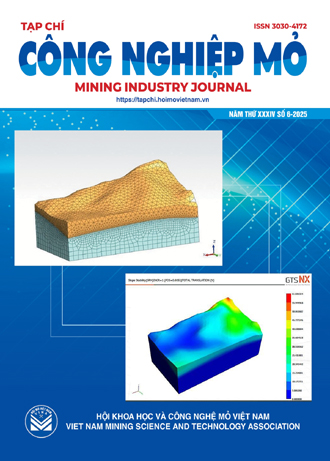
Quá trình thay đổi giá trị thông số cường độ chống cắt của đất tạo nên vùng biến dạng dẻo của mái dốc. Tại trạng thái sau biến dạng, vật liệu sẽ thay đổi và không còn ở trạng thái nguyên dạng như trước, các liên kết trong vật liệu bị phá vỡ và kết cấu bị phá hủy. Trong bài báo này, phương pháp giảm cường độ cắt được sử dụng để xác định cơ chế hình thành, quá trình phát triển, khả năng dịch chuyển cũng như vị trí chính xác của vùng biến dạng dẻo trên bề mặt trượt của mái dốc. Mô hình mái dốc 3D được xây dựng, phân tích, tính toán hệ số an toàn cũng như xác định vùng biến dạng dẻo gây nguy cơ trượt lở mái dốc bằng phần mềm Midas GTS NX tích hợp phương pháp giảm sức chống cắt.


[1]. Zhang, J., Tang, W.H., Zhang, L.M., Huang, H.W. (2012). Characterising geotechnical model uncertainty by hybrid Markov Chain Monte Carlo simulation. Computers and Geotechnics, 43, 26–36. DOI: https://doi.org/10.1016/j.compgeo.2012.02.002
[2]. Rahardjo, H.; Leong, E.C.; Rezaur, R.B. (2002). Studies of rainfall-induced slope failures. Invited Lecture. National Seminar Slope 2000, 27 April 2002, Bandung, Indonesia. In Paulus P Rahardjo(edt.) Slope 2002.Proceedings of the National Seminar, Slope 2002. 15−29;
[3]. Bui, D.T., Ho, T.C., Biswajeet, P., Pham, B.T, Nhu, V.H., Inge, R. (2016). GIS-based modeling of rainfall-induced landslides using data mining-based functional trees classifier with AdaBoost, Bagging, and MultiBoost ensemble frameworks. Environ Earth Sci 75, 1101. DOI: https://doi. org/10. 1007/s12665-016-5919-4
[4]. Cheng, Y.M., Lansivaara, T., Wei, W.B. (2007). Two-dimensional slope stability analysis by limit equilibrium and strength reduction methods. Computers and Geotechnics, 34(3), 137–150. DOI: https://doi.org/10.1016/j.compgeo.2006.10.011
[5]. Wei, W.B., Cheng, Y.M., Li, L. (2009). Three-dimensional slope failure analysis by the strength reduction and limit equilibrium methods. Computers and Geotechnics, 36(1–2), 70–80. DOI: https://doi.org/10.1016/j.compgeo.2008.03.003
[6]. Sarma, S. (1973). Stability analysis of embankments and slopes. Geotechnique, 23 (3), 423–433. DOI: https://doi.org/10.1061/AJGEB6.0000903
[7]. Zienkiewicz, O.C., Humpheson, C., Lewis, R.W. (1975). Associated and non-associated viscoplasticity and plasticity in soil mechanics. Geotechnique, 25(4), 671–689. DOI: https://doi.org/ 10.1680/geot.1975.25.4.671
[8]. Liu, K., Wang, Y., Huang, M., Yuan, W. (2021). Postfailure analysis of slopes by random generalized interpolation material point method. International Journal of Geomechanics, 21(3), 04021015. DOI: https://doi.org/10.1061/(ASCE)GM.1943-5622.0001953
[9]. Fellenius, W. (1927). Erdstatische Berechnungen mit Reibung und Kohasion. Ernst, Berlin (in German).
[10]. Bishop, A.W. (1955). The use of the slip circle in the stability analysis of slopes. Geotechnique, 5(1), 7–17.
[11]. Morgenstern, N.R., Price, V.E. (1965). The analysis of the stability of general slip surfaces. Geotechnique, 15(1), 79–93.
[12]. Spencer, E. (1967). A method of analysis of the stability of embankments assuming parallel interslice forces. Geotechnique, 17, 11–26.
[13]. Janbu, N. (1973). Slope stability computations. Embankment- Dam Engineering: Casagrande Volume, John Wiley & Sons, Inc., New York, 1973, pp. 47-86.
[14]. Dawson, E., Roth, W., Drescher, A. (1999). Slope stability analysis by strength reduction. Geotechnique, 49(6), 835–840. DOI:https://doi.org/10.1680/geot.1999.49.6.835
[15]. Sun, G., Cheng, S., Jiang, W., et al. (2016). A global procedure for stability analysis of slopes based on the Morgenstern-Price assumption and its applications. Computers and Geotechnics, 80, 97–106. DOI: https://doi.org/10.1016/j.compgeo.2016.06.014
[16]. Dyson, A.P., Griffiths, D.V. (2024). An efficient strength reduction method for finite element slope stability analysis. Computers and Geotechnics, 174 (5):106593. DOI: https://doi.org/10.1016/j.com pgeo.2024.106593
[17]. Châu Trường Linh & Nguyễn Thanh Quang (2021). Phân tích ổn định mái dốc nền đường bằng phương pháp cân bằng giới hạn và phần tử hữu hạn theo tiêu chuẩn Aashto – Lrfd. Tạp chí Khoa học và Công nghệ - Đại học Đà Nẵng, vol. 19, no. 4.2.
[18]. Nguyễn Quang Hùng & Trần Văn Quân (2020). Ứng dụng trí tuệ nhân tạo trong dự đoán sức chống cắt của đất sau biến dạng. Tạp chí Khoa học và Công nghệ Thủy Lợi số 60.
Các bài báo khác


 Toà soạn Tạp chí Công nghiệp Mỏ
 Số 226 Đường Lê Duẩn, Quận Đống Đa, Thành phố Hà Nội
 Tel:(+84-24) 36649158 Fax: (+84-24) 366159
 Email:tccongnghiepmo@gmail.com